
Why We Make Applications That Long


This post is second in a series about Systems Administration at CS++.
Revolving Door, but Not.
Societies in TU Dublin are run exclusively by student volunteers, who usually need to be elected every year by members.
While this works for the standard events-side of a society, for CS++'s Systems Administrators, this is slightly harder as the Sysadmins are service providers, manage expensive equipment, and are the data owners of Personally Identifiable Information. All of this requires special training and most importantly, trust.
Neither of those things can realistically be done in a year, so Sysadmins get an exception in how they join and are kept on the committee.
Enter, the Flowchart™️
CS++ used a clause in the All-Societies Constitution that allows non-core committee to be co-opted (Appointed onto the committee without a public election) and applied it to Sysadmins.
To solidify this process, we created a flowchart:
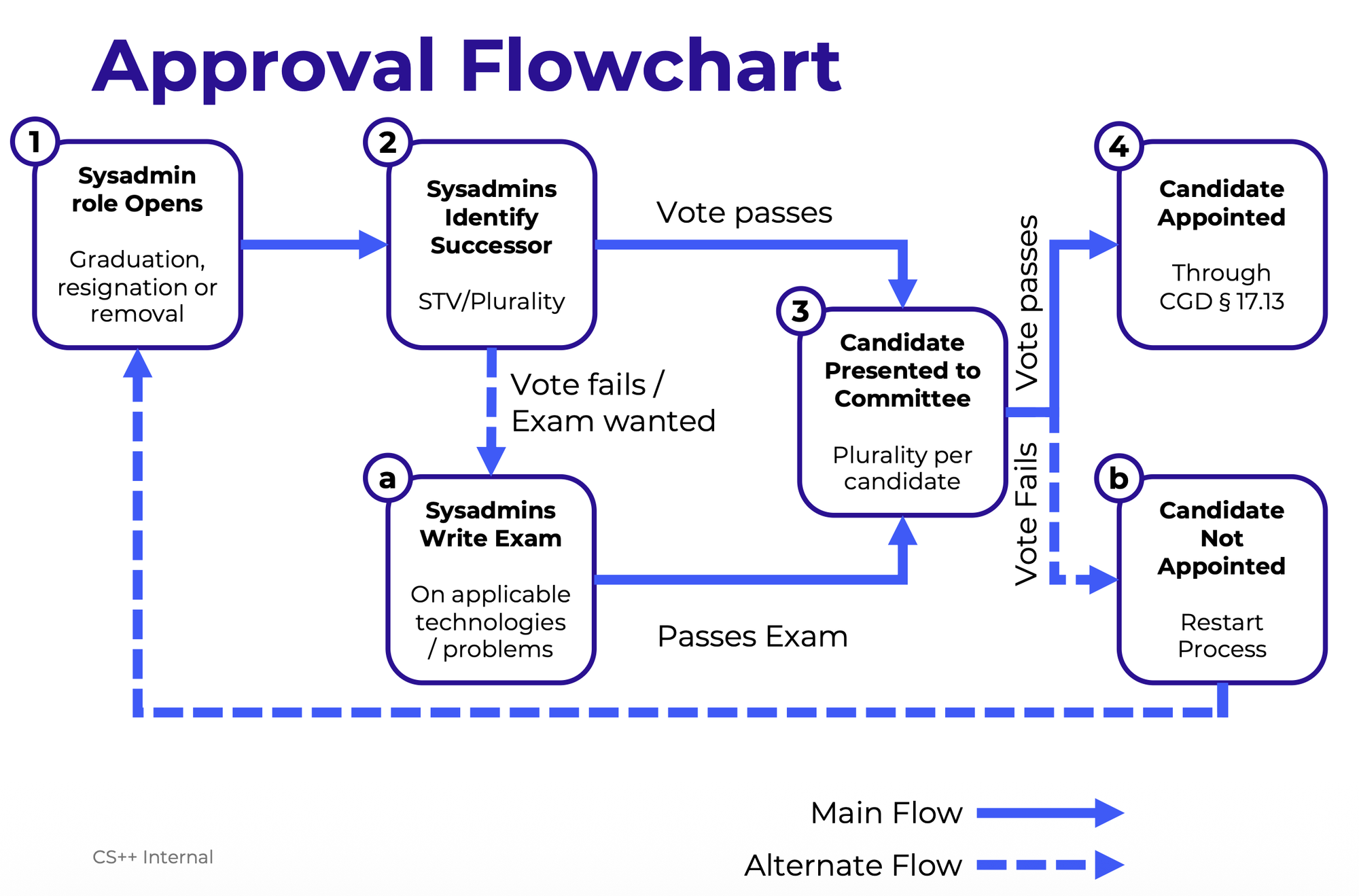
This looks really involved but boils down to the following:
- Sysadmins have an upcoming vacancy
- They open applications for those interested in filling the vacancy
- They then interview a subset of the candidates that they are interested in filling the vacancy
- If they still can't decide, they write a mini 'exam' and present it to the candidates
- They then vote on the preferential candidate
- They present that candidate to the committee as a whole to approve or not approve
- The candidate is appointed as a sysadmin, or the process repeats
All of this setup was needed to be able to answer the main question of this blog post.
Why DO We Make it so Hard to Become a Sysadmin?
Put it simply, the expectation of Sysadmins is higher than that of a standard committee member. With a significantly higher learning curve, more complex workload, and the fact you don't need to be re-elected every year means that not only do they need to be willing to help out, they also need to be trusted!
When seeking out volunteers to fill a role, there are many ways to naturally filter out those who may not be who you are looking for. One of the best ways to do that is by introducing what I call 'speed bumps'.
Traffic Laws, but Not.
Speed Bumps are minor inconveniences or additional steps that you can add that people need to take to achieve their end goal.
THESE NEED TO BE BALANCED.
Every additional Speed Bump will disincentivise some people from applying. If you you add too many, no-one will be bothered to apply.
CS++ uses them just for the Sysadmin application. This year, we asked two questions. Here they are word-for word:
- Why are you interested in becoming a Sysadmin?
- Do you have any experience
While we tend to prioritise experience in Systems Administration, Self-Hosting, Linux, or the Cloud. But, it's not mandatory!
We are also looking for people with time and a willingness to learn!
These are both very straight-forward questions! CS++ says that becoming a Sysadmin is a great way to learn unique skills you wouldn't touch until you get into the industry, as well as giving back. However, some potential applicants might just be interested in getting the title, instead of contributing to the society. This first question disincentivises them as they either have to tip-toe around this fact or lie outright.
That other question is the section Speed Bump. Those with experience will list it here. Any candidates without experience will tend to speak about other related experience, or mention that they are planning to gain experience in this through personal projects. We are looking for both of those candidates. Those with the experience already, and those with genuine interest.
Applicants who are more interested in the title will instead give a shorter answer which makes it clearer they they might be lacking the genuine interest that we are looking for.
What About Nervous Applicants?
We recognise that people may not be able to show their best side through an application, and instead cast a very wide net for interviews!
Interviews are the best way to interact with applicants (as any recruiter will know), as it allows the applicant to show their best side, and the interviewers get to see the true person.
We interview a large chunk of the applicants every year to help applicants give their best shot at joining us, and to give us the highest chance of selecting the best candidates.
Things Change, We Do Too.
Every time CS++ needs new Sysadmins, the landscape is different.
This year is especially difficult for us, as myself and one other Sysadmin is graduating. I've been in the society the whole time I have been at university, and was responsible for restoring our technical footprint, and building out our current technology stack. The other Sysadmin graduating is our webmaster and has been around since their second year.
Because of this, we need to find two candidates that fit one of the two profiles:
- Has a lot of time, and has the drive to learn now and lead later (Ideally a current First Year)
- Have experience and the drive to lead and teach now. (Ideally a Second Year)
This is both to combat the knowledge loss, but also combat the fact that of the three remaining Sysadmins:
- Two are going into the Final Year and will have much less time to contribute
- One is going into their internship, and will not be available during weekdays
But this is just this year, next year the landscape will be different, so the Sysadmin team will have different profiles they are trying to fill.
Actually, it is a Revolving Door.
In a perfect scenario, a Sysadmin joins at the start of their First Year, and leaves when they graduate.
That is still ONLY four years, and makes long term growth and planning very difficult. I've actually spoken about this at FOSDEM in February, 2026.
Because of this, we need to ensure that we select people who will actually contribute and help train up their successors and guarantee continuity.
Every little Speed Bump helps us vet applicants and improves our chances of hitting the mark.
Why Should You Care?
If you're involved in volunteering, especially in Student Life, this approach is great for growing a team of people who love what they do, and will make great things come to life.
If you're a real adult and have the ability to pay people for their work, my shamelessly plugged talk about business continuity and the Bus Factor is for you. Everyone in CS++ knows they have a timer before they move on, but you and your colleagues may not. This talk helps you plan for that!
For people who don't fit neatly into either category, applying Speed Bumps to different areas of your life can help you (and those around you) filter out people or things that you might not want!